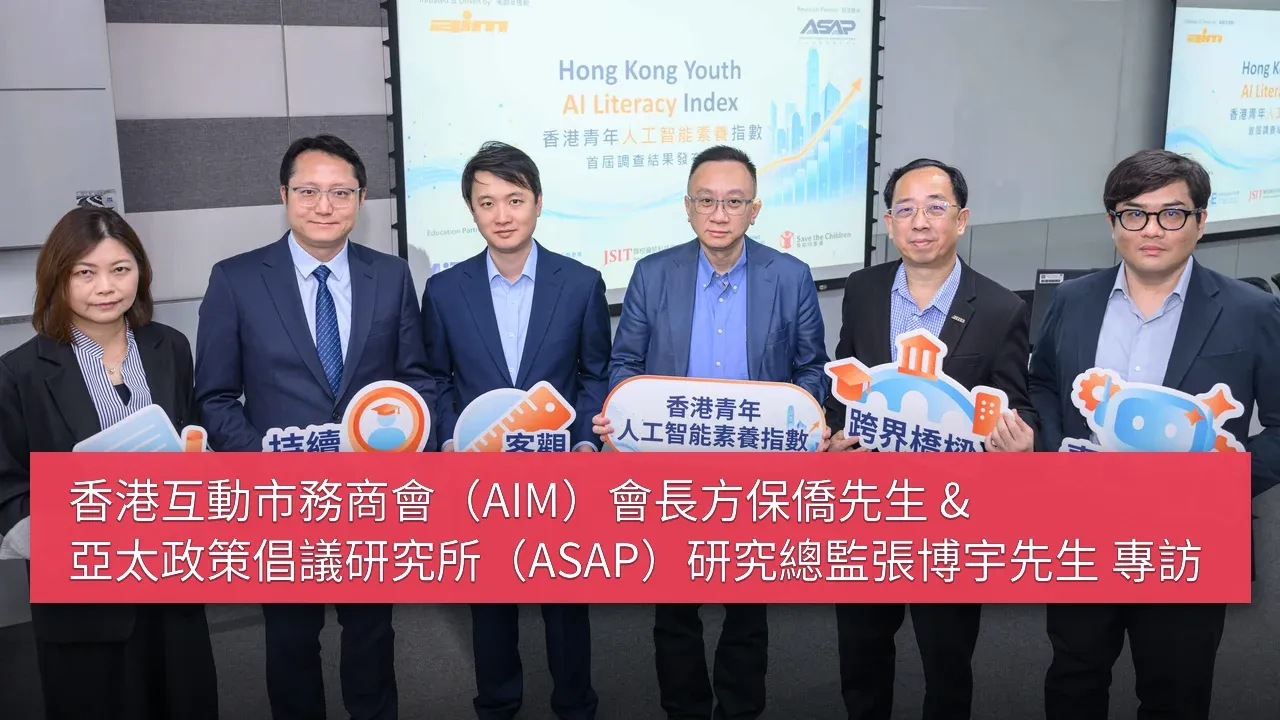

With the rapid development of artificial intelligence (AI) technology, AI literacy has become an important issue in the education sector. The Hong Kong Interactive Marketing Association (AIM) and the Asia-Pacific Policy Initiative (ASAP) recently announced the results of the first "AI Literacy Index for Hong Kong Youth." To gain deeper insights into this topic, we interviewed Mr. Fang Baoqiao, President of AIM, and Mr. Zhang Boyu, Research Director of ASAP, to discuss their views on AI literacy among Hong Kong youth and their vision for future education.
Long-term Vision for AI Literacy Among Hong Kong Youth
Mr. Fang Baoqiao pointed out that AIM's long-term vision is to transform Hong Kong secondary school students from merely "using AI" to "understanding AI, mastering AI, and using AI to create their own outcomes." He emphasized that to achieve this goal, AIM has planned and promoted the "AI Literacy Index for Hong Kong Youth," aiming to establish a set of sustainable baseline data to provide empirical references for AI training and digital education development.
“Our first index recorded a score of 3.65, which serves as a starting point before the Education Bureau fully implements the 'Blueprint for Digital Education Development in Primary and Secondary Schools' starting from the 2026/27 school year.”
Mr. Fang Baoqiao, President of AIM
He added that future surveys will be conducted regularly to assess the actual effectiveness of related measures across different competency areas and to track students' development in AI literacy, including technical understanding and AI data literacy, critical thinking, AI creation, and confidence and attitudes towards learning AI.
Current State of AI Literacy Among Hong Kong Youth
Mr. Zhang Boyu mentioned that the survey results indicate that the overall AI literacy index for participating secondary school students is 3.65, with self-assessments falling between "neutral" and "agree," leaning towards "agree," reflecting a decent overall level. He pointed out that 60.59% of respondents expressed agreement or strong agreement, while only 7.87% disagreed or strongly disagreed.
“Students excel in daily use and value judgment, with ethical awareness, practical application, and human-machine collaboration all scoring 3.81, indicating that a responsible attitude towards using AI has begun to take shape.”
Mr. Zhang Boyu, Research Director of ASAP
He noted that while students performed well in ethical awareness, their scores in theoretical technical understanding (3.62) and AI data literacy (3.58) were relatively weak, with the score for AI creation ability being only 3.22, indicating that this area has yet to be fully developed.
Policy Recommendations for Enhancing AI Literacy
Mr. Zhang Boyu proposed four recommendations to improve AI literacy among Hong Kong youth. He suggested first clarifying the definition and scope of AI, incorporating data, algorithms, computational power, machine learning principles, and algorithmic bias into teachable and assessable learning focuses. Secondly, there should be a continuous enhancement of students' critical thinking abilities, teaching them how to combat "AI hallucinations" through multi-source verification.
“We recommend providing practical opportunities for students to create using AI, such as developing applications or websites.”
Mr. Zhang Boyu, Research Director of ASAP
Additionally, he emphasized the importance of gradually increasing the difficulty of learning activities to build successful experiences and increasing practical opportunities outside the classroom to foster students' confidence and willingness to learn.
Challenges in AI Creation Ability
When discussing the low scores in AI creation ability, Mr. Zhang Boyu pointed out that this reflects an area often overlooked in current AI learning. He suggested that the Education Bureau and schools should allocate more space for hands-on creation, allowing students to use AI to develop applications or websites, thus experiencing the complete process from conception to implementation.
“This also aligns with the 'Blueprint's' requirement to guide students in using AI tools for innovation and collaboration.”
Mr. Zhang Boyu, Research Director of ASAP
He stressed that the rapid development of AI technology requires educators to continuously update teaching methods to ensure that students remain competitive in a constantly changing environment.
Unique Aspects of Hong Kong's AI Education Strategy
Mr. Fang Baoqiao pointed out that Hong Kong's AI education strategy has several unique aspects. Firstly, the 'Blueprint' does not only view AI education as training in tool operation but also considers knowledge, application, ethics, creation, and attitudes, emphasizing the experiences students gain during the learning process.
“Hong Kong's curriculum is relatively cohesive, forming a comprehensive development from primary to secondary education.”
Mr. Fang Baoqiao, President of AIM
He believes that such a strategy not only equips students with the ability to meet the challenges posed by AI technology but also promotes their critical thinking and creativity.
Looking Ahead to Future AI Literacy Education
In conclusion, Mr. Fang Baoqiao emphasized that the key to maintaining competitiveness lies in empirically tracking effectiveness and adjusting policies as needed. He stated that this index provides a baseline before the comprehensive implementation of policies, and future similar surveys will objectively assess progress across different competency areas.
“What truly follows students is a foundational understanding of how AI operates, the habit of critical verification, and the ability to create using AI.”
Mr. Fang Baoqiao, President of AIM
The insights from Mr. Fang Baoqiao, President of AIM, and Mr. Zhang Boyu, Research Director of ASAP, provide direction for AI literacy education in Hong Kong, and the future development is worth looking forward to.
TechRitual 企業科技編輯部(香港)。biz.techritual.com 的外語版本由繁體中文原文翻譯。
