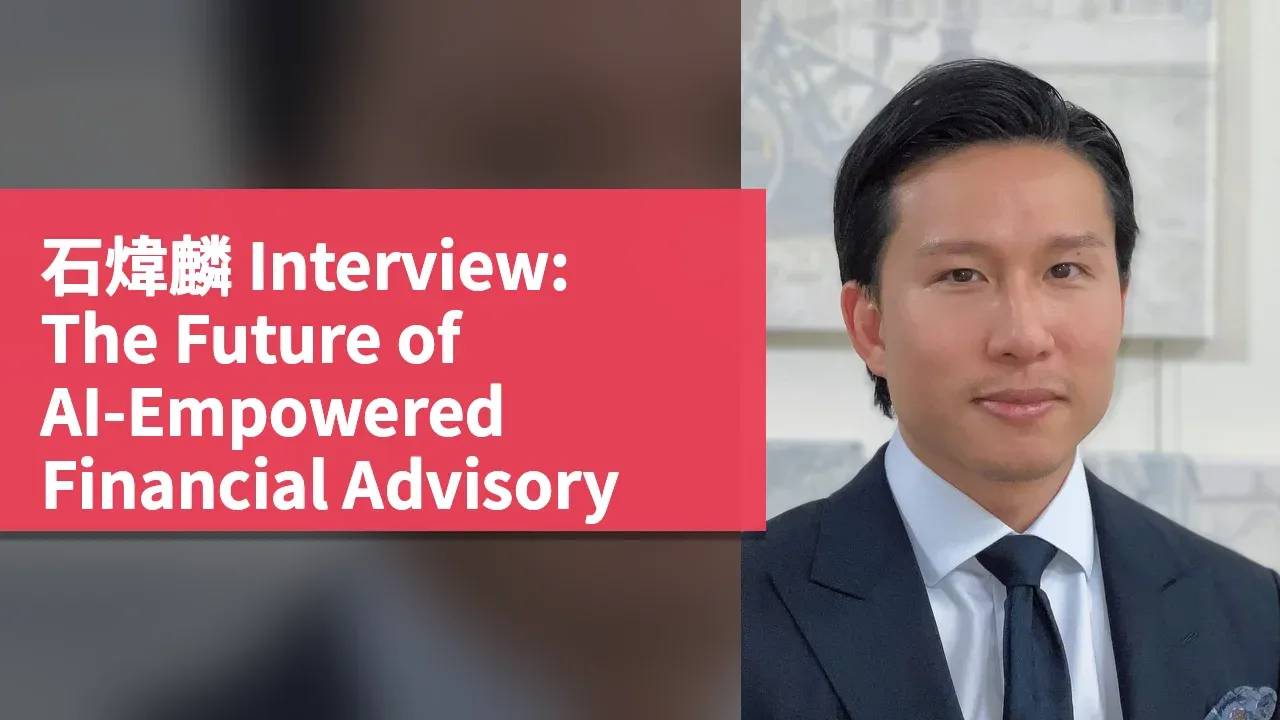
In today's financial markets, the rapid advancement of AI (artificial intelligence) technology is profoundly reshaping how the financial advisory industry operates. According to a recent McKinsey & Company survey, customers are increasingly turning to AI to help make purchasing decisions, yet financial advisors have been relatively slow to adopt the technology in this respect. To better understand this phenomenon, the Techritual editorial team interviewed 石煒麟, McKinsey & Company Global Senior Partner and Managing Partner for Hong Kong.

The Empowering Role of AI Technology
石煒麟 points out that AI is not meant to replace financial advisors, but to empower and accelerate their work. He emphasizes that before making a purchasing decision, customers have already begun using AI to gather information, compare products, and form their own preliminary judgments — meaning that by the time they meet with an advisor, they already have clearer needs and questions in mind.
“Customers have started treating AI as a ‘second opinion’ — using it to interpret terms, compare products, and form preliminary judgments.”
石煒麟, McKinsey & Company Global Senior Partner and Managing Partner for Hong Kong
He further explains that although customers are increasingly relying on AI's data-processing capabilities, they still depend heavily on the professional advice of financial advisors when it comes to major decisions. This shows that financial advisory remains a fundamentally people-centered business, in which advisors' professional expertise and interpersonal skills remain indispensable.
A Long-Term Strategy for Driving AI Adoption
Discussing McKinsey's long-term strategy for driving financial advisors' adoption of AI, 石煒麟 highlighted four key priorities. First, financial institutions should treat “driving team adoption” as a top priority, rather than merely upgrading technology. He noted that institutions should invest as much in training, coaching, and reshaping how financial advisors work as they do in technology itself.
“In markets with high financial advisor turnover, driving widespread adoption is often more important than the technology itself.”
石煒麟, McKinsey & Company Global Senior Partner and Managing Partner for Hong Kong
Second, 石煒麟 noted that a solid data foundation must be established before scaling up, because the effectiveness of AI depends on the integrity of the underlying systems. In addition, embedding the expertise of top financial advisors into the system is key to improving service quality. Finally, he stressed that institutions should invest in human skills that AI cannot replicate — these soft skills will become advisors' core competitive advantage in the future.
Meeting Changing Customer Expectations
As customer acceptance of AI grows, 石煒麟 points out that customer expectations of financial advisors are changing accordingly. Surveys show that by the time customers meet with a financial advisor, they have often already obtained AI-generated information and comparisons, raising the bar for the quality of advice advisors must provide. He emphasizes that customers' expectations of advisors are no longer limited to providing information — they now expect deeper contextual understanding and professional advice.
“Customers now hold financial advisors to higher, more precise standards.”
石煒麟, McKinsey & Company Global Senior Partner and Managing Partner for Hong Kong
He adds that when making major decisions, customers still want financial advisors' judgment and sense of accountability, meaning advisors need to strengthen trust with customers while providing professional advice.
Future Industry Trends
石煒麟 offered his forecast for the future of Hong Kong's financial advisory industry. He said that a divide is emerging in Hong Kong's financial advisory industry — not between humans and AI, but between “advisors who use AI” and “advisors who do not.” He noted that as the industry matures and products become more complex, advisors' coaching skills will become their core competitive strength.
“Institutions that successfully integrate AI into financial advisors' daily work will be better positioned to strengthen customer engagement and boost productivity.”
石煒麟, McKinsey & Company Global Senior Partner and Managing Partner for Hong Kong
In summary, the introduction of AI has not only changed customer behavior but also raised expectations of financial advisors. Going forward, advisors will need to leverage AI to provide more personalized, professional services that meet customers' ever-growing needs.
TechRitual 企業科技編輯部(香港)。biz.techritual.com 的外語版本由繁體中文原文翻譯。
