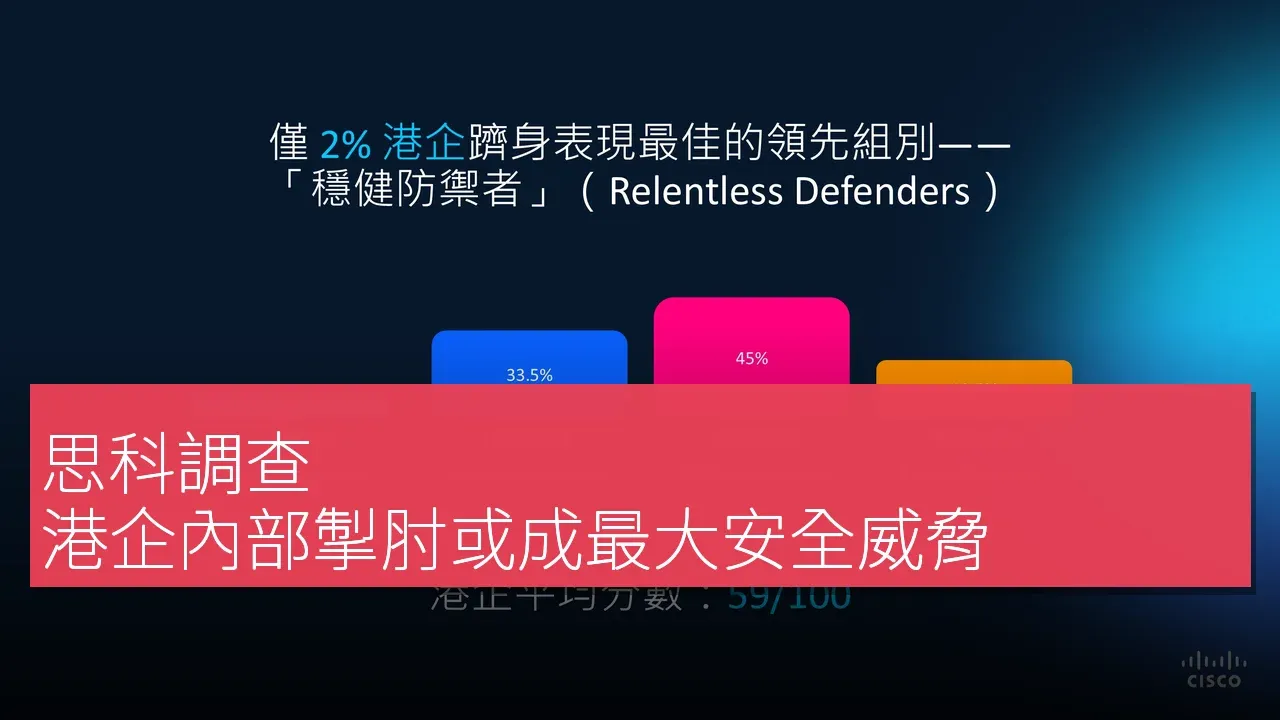

Cisco's latest "Continuous Defense Report" indicates that internal operational constraints within enterprises may be the primary threat affecting cybersecurity. The survey shows that while the rapid development of AI has accelerated the evolution of cyber threats, internal approval delays, data silos, and insufficient team collaboration have become stumbling blocks for enterprise defense.
Survey Results Overview
According to the report, over the past 12 months, 91% of surveyed enterprises globally (89% in Hong Kong) experienced serious cybersecurity incidents, which had significant impact on business. Among these, over one-third of incidents involved AI-enhanced attacks.
The report points out that obstacles in enterprise operations are the key factor in improving defense capabilities; approximately 60% of cybersecurity personnel believe that improving cross-team coordination, approval processes, and data access is more important than technology itself.
Challenges of Insufficient Internal Collaboration
The survey also shows that insufficient collaboration between teams is the main obstacle for enterprises to strengthen cyber defense. Globally, only 41% of surveyed enterprises (46% in Hong Kong) reported that security, network, and IT teams can operate collaboratively in a single-team model, sharing visibility and tools.
Additionally, 43% of enterprises stated that their measured metrics are too technical to influence management decisions; while 40% of enterprises spend more time on data collection and integration than on actually responding to threats.
AI Application and Challenges
Although over 80% of cybersecurity personnel globally report that threat detection and response speed has improved by at least 25% after using AI, fewer than half of enterprises currently deploy AI-driven security functions at scale. Only one-third of enterprises widely use AI agents in security operations, and merely 54% of respondents feel very confident in their ability to detect and respond when AI agents come under attack.
Conclusion
Cisco Senior Vice President and General Manager of Security, Visibility, and Data Platform Sunil Potti stated that the key to driving AI adoption lies in building trust, and trust can only be truly established when security and resilience are inseparable. Enterprises need to fundamentally improve internal collaboration to effectively address evolving cyber threats.
TechRitual 企業科技編輯部(香港)。biz.techritual.com 的外語版本由繁體中文原文翻譯。
